08 / Individual graduate coursework · Measurement exercise
Digital Marketing KPI Plan
I developed a set of KPIs for a retail marketing scenario. I considered how to measure campaign results and what sales and customer-service teams would need as demand changed.
University of Washington · Program Management and Consulting
Project at a glance
- Project type
- Individual graduate coursework · Measurement exercise
- My role
- Selected five KPI areas and explained measurement options.
- Objective
- Connect marketing measurement to customer response and operational needs.
- Key deliverables
- Five-part KPI plan and discussion of cross-functional effects.
- Tools / methods
- Leading/lagging indicators, measurement planning, business analysis.
- Outcome / status
- Classroom measurement framework; no live campaign results.
The problem
The scenario needed a way to judge marketing efforts while keeping attention on customer experience and the teams supporting new demand.
My contribution
I selected five KPI areas, explained how they could be measured, and discussed why a mix of forward-looking signals and observed results was useful.
The work
- Defined conversion rate, customer acquisition cost, social-media followers, customer feedback, and sales by ad type.
- Considered how campaign attribution, surveys, and platform reporting could support measurement.
- Discussed how business goals and competitor research could inform targets.
- Connected increased demand to sales and customer-service capacity.
How the solution took shape
Start with the business decision
The retail scenario needed to understand whether digital marketing was bringing in customers. I considered both the results of campaigns and the signals that could help the business plan future activity.
Choose five areas to measure
I selected conversion rate, customer acquisition cost, social-media followers, customer feedback, and sales by ad type. Together, they covered purchasing behavior, acquisition effort, audience response, and campaign outcomes.
Explain where measurement could come from
I discussed campaign attribution, customer surveys, promotional offers, and platform reporting as ways to connect activity to customer response. The assignment described possible measurement methods; it did not connect to a live customer dataset.
Balance indicators and consider targets
I explained the value of combining leading and lagging indicators so the business could consider future demand alongside observed results. I also discussed using business goals and competitor research when setting targets, without presenting invented target values.
Connect marketing to operations
I considered what would happen if campaigns increased sales and customer-service demand. The plan needed input from those teams because a successful campaign could still create a poor experience if the business could not support the additional customers.
Deliver a measurement framework
The completed assignment explained the KPI choices, possible ways to measure them, and their effects across departments. It provided a basis for planning and review; it did not establish campaign ROI or a measured increase in sales.
A closer look
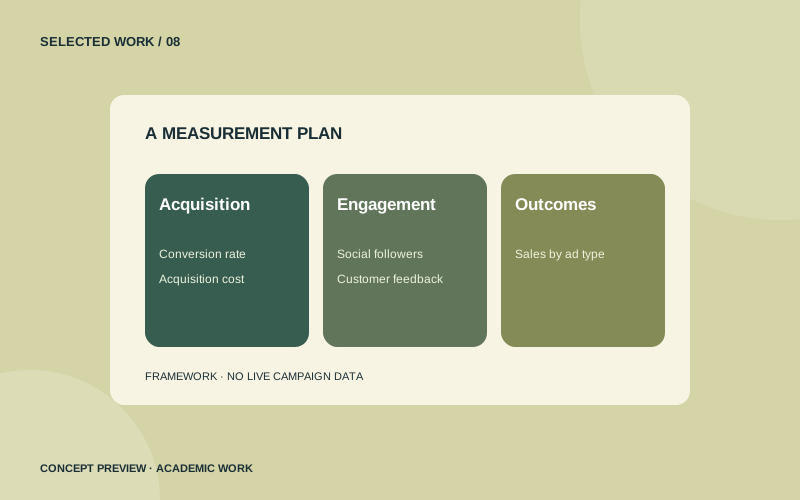
Five measures, three decision areas
Acquisition
Conversion rate and customer acquisition cost: assess whether marketing brings in customers.
Engagement & feedback
Social-media followers and customer feedback: understand audience response.
Campaign results
Sales by ad type: compare the outcomes associated with different ads.
Cross-functional check
Can sales and customer service support the demand generated?
An example from the work
Measuring demand and the ability to support it
Campaign results alone do not show whether the business can support additional customers. I connected the marketing measures to the workload and service experience that could follow.
The project in numbers
Completed analysis
5 KPI areasDefined in the assignment
A measurement framework covering acquisition, engagement, customer feedback, and campaign results. No numerical performance targets are presented as achieved.
What came out of it
The assignment produced a five-part measurement plan and a discussion of cross-functional effects. It did not include live campaign data or measured changes in sales.
This work shows how I choose useful measures and connect them to decisions beyond a single team.
Project scope and limits
Classroom retail case. No live campaign, customer dataset, or verified performance improvement is claimed. The visual groups the original KPI areas by their purpose; it is not a dashboard of results.