05 / Graduate team project · Survey research
Smart Home Privacy Research
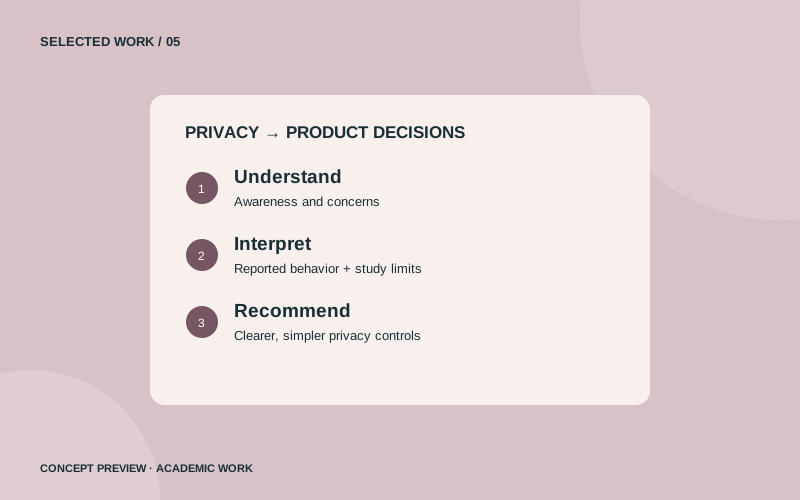
Our team studied how people think about privacy and security in smart home devices. I prepared an executive summary that connected the findings to practical recommendations and explained the limits of the research.
University of Washington · Data Driven Organizational Problem Solving
Project at a glance
- Project type
- Graduate team project · Survey research
- My role
- Contributed to team research; wrote the executive summary and recommendations.
- Objective
- Understand awareness, concerns, and reported privacy behavior.
- Key deliverables
- Executive summary, recommendations, and research limitations.
- Tools / methods
- Survey research, evidence synthesis, sampling and self-report review.
- Outcome / status
- Exploratory classroom findings; not representative of all users.
The problem
Smart home devices can make daily tasks easier while introducing privacy and security concerns. The research asked what users understood, what concerned them, and what actions they reported taking.
My contribution
I contributed to the team research and prepared an individually attributed executive summary. I also developed recommendations and discussed the study's limitations. The survey and broader project were team work.
The work
- Connected the research question to user awareness, concerns, and reported behavior.
- Summarized survey findings for a decision-making audience.
- Recommended simpler privacy settings and clearer explanations for users.
- Explained sampling and self-report limitations and proposed further research.
How the solution took shape
Frame the research question
Our team focused on what smart home users understood about privacy and security, what concerned them, and what actions they reported taking. This gave the study a connection between attitudes and behavior.
Gather survey evidence as a team
The team used a survey to explore awareness, concerns, and reported actions. The sample came largely from the researchers’ immediate circles, which mattered when interpreting the findings.
Look for the pattern behind the responses
In my executive summary, I brought together the findings on awareness, privacy concerns, and reported use of security choices. The main issue was a gap between concern and the actions respondents said they took.
Check how much the evidence could support
I explained that the sample was concentrated among relatively educated and employed respondents and that the behavior was self-reported. Those limitations meant we could not treat the findings as representative of every smart home user or establish why people made particular choices.
Develop practical recommendations
I connected the findings to clearer explanations and simpler privacy settings, alongside broader public awareness. The aim was to make it easier for users to understand and act on their choices; the study did not test the effectiveness of a redesigned interface.
Define what further research should answer
I recommended a larger and more diverse sample, qualitative interviews, and research over time. These would help explore the reasons behind reported behavior and whether awareness or decisions changed.
A closer look
Connecting the research to recommendations
| What the study described | Recommended next step |
|---|---|
| Privacy concern did not consistently translate into reported action | Make privacy controls and explanations easier to understand. |
| Respondents came largely from the researchers’ circles | Recruit a broader, more diverse sample. |
| Behavior was self-reported | Add interviews and other methods to understand decisions. |
An example from the work
A recommendation tied to the findings
Manufacturers could make privacy settings easier to understand. A broader sample and follow-up interviews would help test whether unclear settings explain the gap between concern and reported behavior.
What came out of it
The summary described a gap between concern about privacy and the actions respondents reported taking. The recommendations focused on making controls easier to understand and improving the evidence through broader research.
This project shows how I turn research into a recommendation while being clear about what the evidence can support.
Project scope and limits
Exploratory classroom research with a convenience sample and self-reported behavior. Findings are not representative of all smart home users.