07 / Graduate coursework · Governance analysis
Healthcare Data Governance
I compared governance approaches for a nonprofit healthcare scenario. The analysis focused on matching controls to the information being managed, rather than using the same approach for every department.
University of Washington · IMT 500
Project at a glance
- Project type
- Graduate coursework · Governance analysis
- My role
- Compared governance models and information risks.
- Objective
- Match governance approaches to patient-record and HR needs.
- Key deliverables
- Model comparison and discussion of risks and tradeoffs.
- Tools / methods
- Data-governance analysis, risk assessment, operating-model comparison.
- Outcome / status
- Academic scenario analysis; no implemented program or compliance audit.
The problem
The scenario involved sensitive patient information alongside HR information connected to other business systems. Each area needed clear controls, but the day-to-day needs were different.
My contribution
In my coursework, I evaluated the risks of weak information governance and compared centralized and hybrid models for records and HR.
The work
- Outlined risks from outdated sources, inappropriate access, and fragmented information.
- Compared centralized controls for patient records with a hybrid model for HR.
- Considered flexibility, consistency, and the risk of department-level silos.
- Explained why changes to systems and ownership would also require policy review.
How the solution took shape
Separate the information needs
I considered patient records and HR information within the nonprofit healthcare scenario. Both needed governance, but the sensitivity of patient records and HR’s connections to business applications created different requirements.
Identify what could go wrong
My analysis described risks from outdated sources, inappropriate access, and information spread across separate systems. I used examples such as a change in the person responsible for a record to show why reliable sources and clear access rules would matter.
Compare governance models
I considered centralized governance for records and a hybrid approach for HR. The comparison looked at consistent controls alongside the flexibility needed to work across connected applications.
Connect each choice to the department
For records, I emphasized protecting sensitive information through consistent governance. For HR, I considered how a hybrid model could support its relationship with ERP and other systems. These were recommendations within the scenario, not controls I implemented.
Examine the tradeoff of using both
I explained that different models could suit different business needs while also creating silos. If systems or information ownership changed, the policies might need to change too. The final comparison made that ongoing coordination requirement explicit.
A closer look
Two departments, different governance needs
| Scenario department | Approach considered | Reason |
|---|---|---|
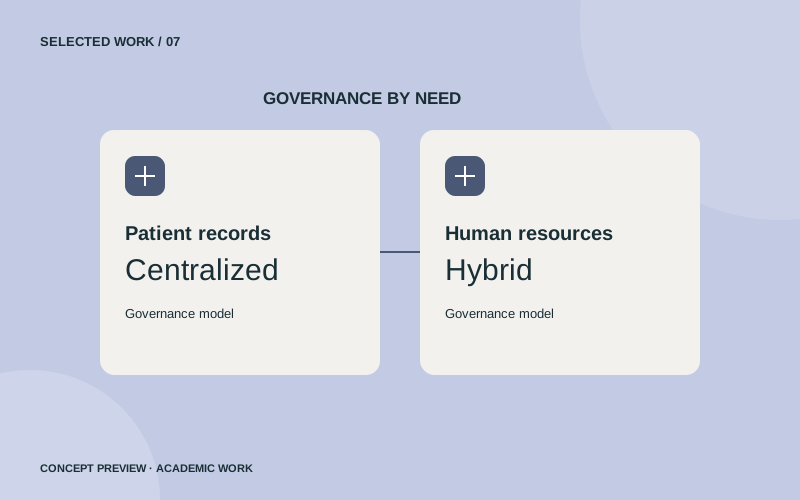
| Patient records | Centralized governance | Consistent control of sensitive information. |
| Human resources | Hybrid governance | Flexibility across connected business applications. |
Shared challenge
Keep information from becoming siloed, and revisit policies when systems or ownership change.
An example from the work
Matching the model to the department
I recommended a centralized approach for records because of the sensitivity of patient information. For HR, I considered a hybrid approach because of its connections to ERP and other applications.
What came out of it
The coursework produced a comparison of two governance models and a discussion of the tradeoffs of using both within one organization.
This work shows how I connect information risk to a practical operating-model choice.
Project scope and limits
Academic healthcare scenario. No patient data is included. The analysis is not an implemented governance program, a compliance audit, or a determination of legal compliance.