02 / Graduate team project · Consulting proposal
Business Operations Transformation
Our team proposed a project management office to support a growing business. I focused on how the work would be managed, how progress would be reported, and how risks would reach the right people.
University of Washington · Program Management and Consulting
Project at a glance
- Project type
- Graduate team project · Consulting proposal
- My role
- Developed the team proposal’s management approach.
- Objective
- Coordinate a growing business through a proposed PMO.
- Key deliverables
- Management structure, reporting cadence, risk-review approach, and team RFP response.
- Tools / methods
- Governance design, phased planning, KPI reporting, risk reviews.
- Outcome / status
- Academic proposal completed; PMO not implemented.
The problem
The case described a growing business with disconnected systems and inconsistent processes. The team needed a way to prioritize initiatives, coordinate work across departments, and give leadership a clearer view of progress.
My contribution
I developed the management approach covering the delivery structure, responsibilities, status reporting, and risk reviews. The full proposal was a team effort and also included discovery, change management, governance, and cost planning.
The work
- Defined responsibilities across program leadership, project managers, and analysts.
- Outlined weekly operational reports and monthly stakeholder reviews.
- Connected quarterly executive reviews to milestones, issues, and decisions.
- Described how the team would identify and monitor risks across workstreams.
How the solution took shape
Start with the coordination problem
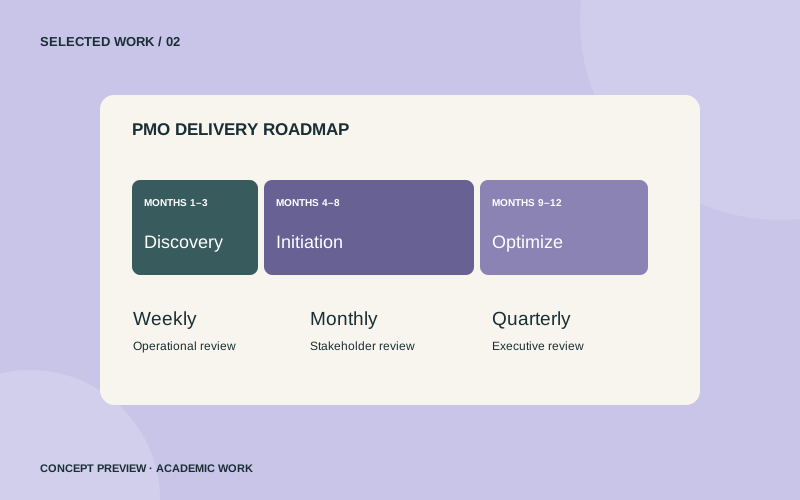
Our team used the case requirements to frame a PMO proposal around disconnected systems and inconsistent processes. The proposed base-year sequence moved from discovery to PMO initiation and then optimization.
Define who would make decisions
For my management approach, I described a tiered structure with an executive sponsor, program manager, project managers, and analysts. The purpose was to distinguish strategic direction from day-to-day coordination and execution.
Assign responsibilities to the work
I connected the roles to initiative prioritization, timeline tracking, KPI reporting, process improvement, and the tools used to make performance visible. This made the organization model more useful than a list of job titles.
Design reporting around the audience
I outlined weekly status reporting on progress, milestones, issues, and immediate actions. Monthly stakeholder reviews would address workstream performance and KPI changes; quarterly executive reviews would focus on strategic updates and decisions.
Build risk review into the proposed routine
I proposed stakeholder input, planning workshops, and assessments of risk likelihood. The areas included change, technology, data, resources, and governance. Risk reviews were part of the reporting cycle so concerns could reach the appropriate decision makers.
Bring the approach into the team proposal
The management approach became part of the final RFP response alongside the team’s discovery, governance, change-management, and cost planning. The deliverable explained how the engagement would be run; it did not report an implemented PMO.
A closer look
The proposed 12-month PMO plan
Discovery
PMO initiation
Optimization
| Review cadence | Focus |
|---|---|
| Weekly | Progress, risks, and immediate actions |
| Monthly | Performance across workstreams |
| Quarterly | Executive decisions and strategic updates |
An example from the work
The proposed reporting approach
Weekly reviews covered progress, risks, and immediate actions. Monthly reviews covered performance across workstreams. Quarterly reviews brought major decisions and strategic updates to executive sponsors.
The project in numbers
Proposal scope
12 monthsProposed base-year plan
The team planned discovery for months 1–3, PMO initiation for months 4–8, and optimization for months 9–12. These are proposed phases, not completed client work.
What came out of it
The team delivered an RFP response with a phased plan for establishing and improving a PMO. The proposal shows how I organize accountability and reporting around a shared delivery plan.
This project shows how I make a complex initiative easier to manage through clear ownership, reporting, and escalation.
Project scope and limits
Academic proposal, not an implemented client engagement. Proposed benefits, staffing, and costs are planning assumptions.