06 / Academic project · Graduate coursework · Scheduling exercise
Website Resource & Schedule Planning
I examined a website project schedule to see where overlapping tasks exceeded the team’s available hours. The exercise made the tradeoff between staffing capacity and delivery dates visible.
University of Washington · IMT 587
Project at a glance
- Project type
- Academic coursework · Graduate coursework · Scheduling exercise
- My role
- Analyzed resource conflicts and compared the exercise schedules.
- Objective
- Check whether overlapping work fit available team capacity.
- Key deliverables
- Resource-allocation analysis and before/after schedule comparison.
- Tools / methods
- Resource leveling, capacity analysis, critical-path review.
- Outcome / status
- Classroom schedule increased from 88 to 98 days after leveling.
The problem
A website plan assigned work that looked reasonable task by task, but exceeded available capacity when tasks ran at the same time.
My contribution
My submitted analysis identified the overloaded resource groups and explained how the project schedule changed after resource leveling.
The work
- Identified concurrent work competing for business-analysis and vendor-development capacity.
- Compared planned daily hours with available resource hours.
- Documented the change in overall project duration after leveling.
- Explained how moving work affected the critical path.
How the solution took shape
Review assignments across the schedule
I examined where tasks overlapped and which resource groups they used. Looking at one task at a time would miss the problem: several tasks could each have a reasonable assignment while their combined demand exceeded the same team’s available hours.
Add up the concurrent demand
For business analysis, the website-foundation work required 6 hours per day and the test plan required another 4. Together, that was 10 hours against 8 available. At the vendor group’s peak, reservations, trail-guide work, donations, and foundation work added up to 8 + 8 + 12 + 4 = 32 hours per day against 24 available.
Identify the resource conflict
I documented business analysis and vendor development as the overallocated groups and tied the conflicts back to the overlapping tasks. The constraint was the shared resource capacity, so the schedule could not be judged only by each task’s individual allocation.
Compare the plan before and after leveling
I reviewed the task dates and durations in the before-and-after schedules. The leveled plan moved work to avoid overusing the same resources. My analysis identified the donations work as the critical-path task associated with the overall extension.
Calculate the effect on delivery
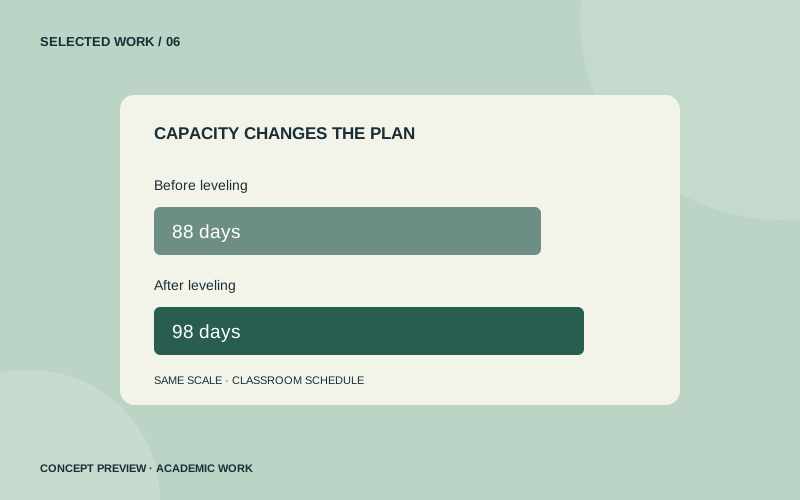
I compared the total project duration: 98 days after leveling minus 88 days before leveling equals an additional 10 days. The chart below shows this overall change using the same scale for both schedules.
Explain the planning tradeoff
The original completion date depended on more concurrent capacity than the exercise made available. My analysis made that conflict and the resulting schedule extension visible. It provided a basis for discussing dates and staffing, rather than presenting the 88-day plan without its resource constraint.
A closer look
The schedule tradeoff after resource leveling
0-day baseline · same scale · leveling adds 10 days
| Resource group | Daily capacity | Peak demand before leveling |
|---|---|---|
| Business analysis | 8 hours/day | 10 hours/day |
| Vendor development | 24 hours/day | 32 hours/day |
Actual project artifacts
Samples from the project
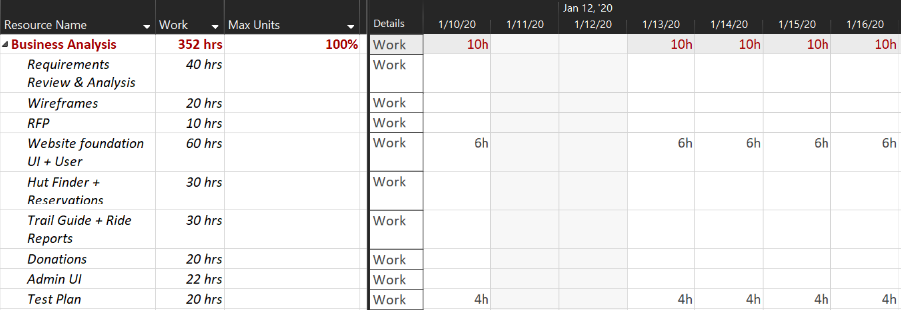
Original resource-usage screenshot showing the 6-hour foundation assignment and 4-hour test-plan assignment contributing to a 10-hour day. Classroom exercise.
View full size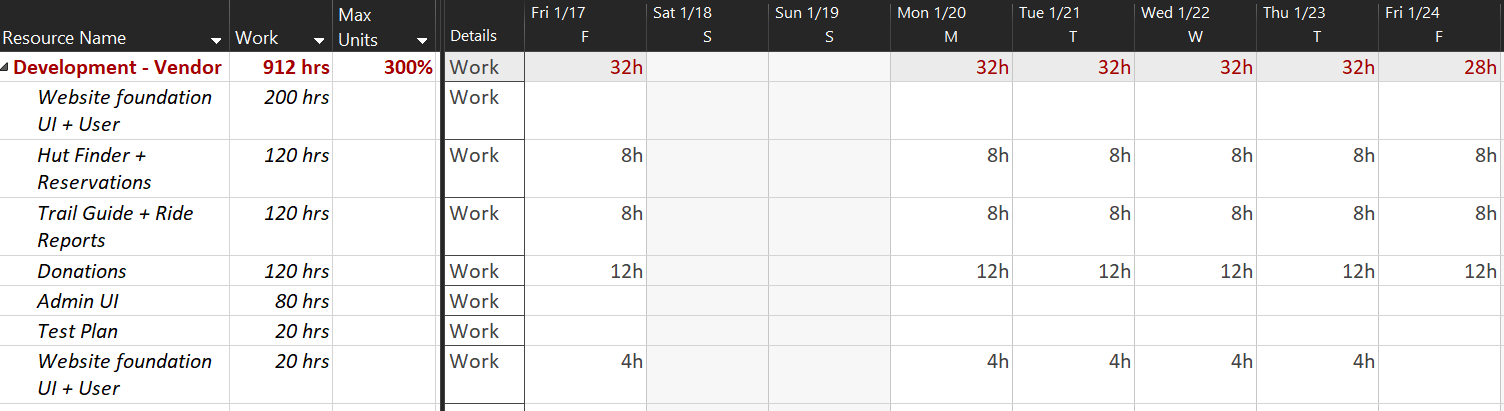
Original resource-usage screenshot showing concurrent assignments totaling 32 hours per day for the vendor group. Classroom exercise.
View full size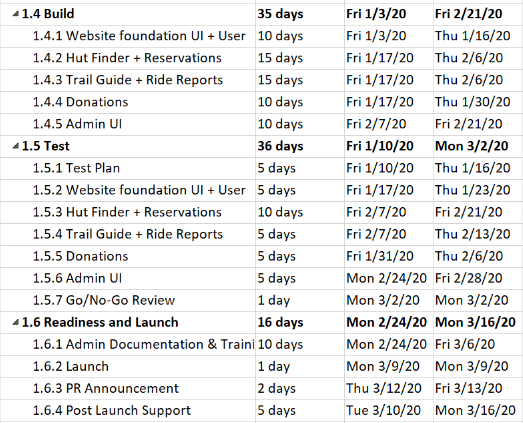
Original before-leveling schedule excerpt, including the build, test, and launch work. This excerpt shows part of the schedule discussed above.
View full size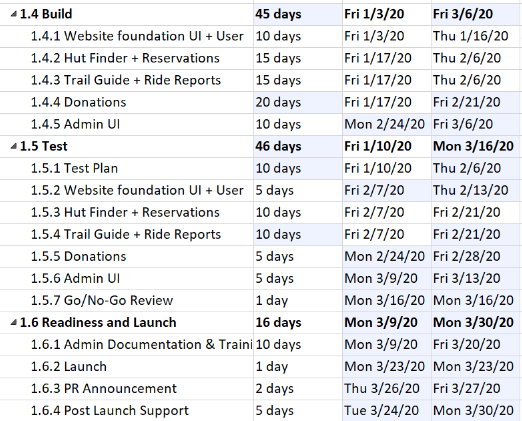
Original after-leveling schedule excerpt showing changes to task durations and dates. Classroom schedule, not a client delivery.
View full sizeAn example from the work
Capacity changes the delivery conversation
The business-analysis resource had 10 hours of work assigned against 8 available hours per day. The vendor-development group reached 32 assigned hours against 24 available hours per day. Looking at the combined demand exposed the conflict.
The project in numbers
Classroom schedule result
88 → 98 daysProject duration after leveling
A 10-day increase in the exercise schedule; this is a capacity tradeoff, not a delay on an actual delivery.
What came out of it
The exercise showed a project duration of 88 days before leveling and 98 days afterward. The additional 10 days made the schedule reflect resource limits rather than assume everyone could work on overlapping tasks.
This work shows how I check a plan against available capacity and explain the effect on delivery dates.
Project scope and limits
Classroom scheduling exercise. These figures describe the assignment schedule, not a client delivery or a productivity gain.